About This Pattern
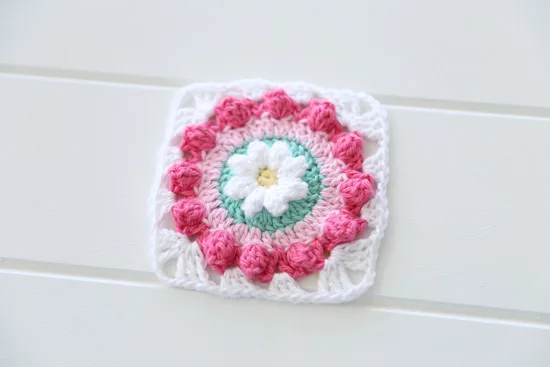
This pattern gives you a daisy granny square: a flower motif with a bright center, white petals, and a leafy green transition that squares off into a classic granny frame. It is written in both UK and US shorthand, so it travels well no matter which terminology you grew up reading. It is perfect for crocheters who love making the same square over and over in different colorways, and for anyone who wants a flower motif that actually blocks into a true square instead of a soft, floppy blob.
The techniques here are all familiar ones used with a little more precision than usual: working into a ring, petal shaping, corner spaces, and five separate color changes across the square. You will change from Yarn A to Yarn B, C, D, and E, which means weaving in ends is a real part of the job, not an afterthought. The pattern runs three rounds in the shorthand versions plus a two-round main pattern section and a chart, so plan on roughly one to two hours for your first square and noticeably less once the rhythm clicks.
Finished, you get a firm, flat motif with a sunny Citrus Lemon center, white daisy petals, and pale green, pale pink, and coral pink working outward to the edge. In 8ply cotton on a 3.5 mm hook the square is small and dense, with crisp stitch definition that shows off the petals. Wet-block it, pin it flat, and let it dry, and the edges come out straight and ready to join. A stack of these makes a gorgeous blanket, cushion cover, tote panel, or a set of coasters for a gift.
- Start with your center color and work into a ring to form the small flower heart at the middle.
- Change to white and work the petal round so the daisy shape appears around that center.
- Count your stitches at the end of every round before you cut and change colors.
- Continue with the pink and coral rounds, working corner groups so the motif squares off cleanly.
- Fasten off and weave each color's tail into the back of matching stitches with a yarn needle.
- Dampen the square, pin it flat with the corners pulled square, and let it dry completely.
- Repeat for as many squares as your project needs, blocking each one to the same measurement before joining.
Materials
Choosing the yarn
Crochet Hook
Other Supplies
Skill Level
Materials
Crochet Abbreviations
- ch
- chain
- st
- stitch
- sc
- single crochet
- dc
- double crochet
- tr
- treble crochet
- dtr
- double treble crochet
- rnd
- round
Crochet Daisy Granny Square Pattern (Free 3-Round Motif)
Daisy Wheel Granny Square – UK Shorthand
- Round 18dc into a magic ring
- Round 2(1pc, ch1) into each dcRnd 3 – 4tr in each ch-1 sp Rnd 4- alternate 1tr, 2tr around
- Round 5(tr, ch1, tr, ch1) skip a stitch (pc, ch1) aroundAttach Yarn E, ch4 (counts as 1tr, ch1), tr in the same st, ch1, skip a st and work one pc into the next, ch1. * skip a st, (tr, ch1, tr) in the next, ch1, skip a st, pc in the next, ch1 * repeat from * to 10 more times. Ss into 3rd ch of inital ch4 and fasten off. (12pc, 12v st).Rnd 6 – (3dtr, ch3, 3dtr) at corners (ch1, 3tr, ch1, 3tr, ch1) along sides.
Daisy Wheel Granny Square –US Shorthand
- Round 18sc into a magic ring
- Round 2(1pc, ch1) into each scRnd 3 – 4dc in each ch-1 sp Rnd 4 – alternate 1dc, 2dc around
- Round 5(dc, ch1, dc, ch1) skip a stitch (pc, ch1) aroundRnd 6 – (3tr, ch3, 3tr) at corners (ch1, 3dc, ch1, 3dc, ch1) along sides.
Main Pattern
- Round 3Attach Yarn C at any ch-1 sp, ch3 (counts as first tr), 3 more tr into the same sp. Work 4tr into each of the remaining 7 ch-1 sps, ss into the third ch of the initial ch3 and fasten off. (32tr)
- Round 4Attach Yarn D, ch3 (counts as first tr), skip a stitch, 2tr in the next. Alternate between 1tr, 2tr around. Ss into top of inital ch3 and fasten off. (48tr)
Chart
Please note that the chart does not include starting and finishing points. Use the chart in conjunction with the written instructions.
Attach Yarn A at to any v st and ch4 (counts as first dtr), 2dtr, ch3, 3dtr in the same sp (this forms your first corner). Ch1, 3tr in the next v st, ch1, 3tr in the next v st, ch1. * (3dtr, ch3, 3dtr) in the next v st, ch1, 3tr in the following v st, ch1, 3tr in the next v st, ch1, repeat from * twice more and then ss into top of inital ch4. Fasten off. (4x {3dtr, ch3, 3dtr}, 8x 3tr groups at sides).
More photos


Important Notes
💡 Stick with a 3.5 mm hook for the recommended 8ply cotton. It is deliberately a touch small for the yarn, which is what keeps the fabric firm enough for the petals to hold their shape and the square to stay square.
💡 Wind small butterflies or bobbins of Yarns C, D, and E before you start. You only need a short length of each per round, and pre-cutting saves you dragging five full balls around while you work a tiny square.
💡 Drop a stitch marker into the first stitch of each new round, especially on the granny rounds. On a square this small it is easy to lose the join, and a marker means you can count from a known point instead of guessing.
💡 Make one full test square before you commit to a whole blanket's worth. Measure it, note the size, and use that number as your target when you block every following square so the joins line up perfectly.
💡 Weave each color's ends in immediately after you cut it, while you still know which tail belongs to which round. On a five-color square, leaving them all to the end turns a five-minute job into a confusing twenty-minute one.
💡 Keep a scrap of paper or a row counter beside you and tick off each round as you complete it. With three rounds in the shorthand version and two in the main pattern, losing your place mid-color is easier than it sounds.
💡 If your corners look rounded rather than sharp after blocking, pin harder into the corner spaces next time and let the square dry fully. Cotton takes a block beautifully, but only if it dries completely pinned.
Common Mistakes and Fixes
Skipping the stitch count and only noticing at the corners that something is off.
Count at the end of every single round before you change color, exactly as the pattern reminds you to. Count the stitches along one side and the groups in each corner. A granny motif hides an extra or missing stitch beautifully until the round after, when your corners suddenly stop lining up and one side bows. Two seconds of counting saves you ripping back a full color.
Pulling the color changes too tight, so the square puckers where Yarn A meets Yarn B.
When you join a new color, keep the working loop the same size as your normal stitches instead of yanking the tail snug. Draw the new yarn through, then give the old tail a gentle tug only enough to close the gap. If a join still dimples, loosen it and re-secure it later while weaving in rather than tightening further.
Working the petal round into the wrong loops so the daisy sits flat and shapeless instead of standing proud.
Read the round against the chart before you start it. The petals need to be anchored consistently, so check where the first petal lands relative to the center and mirror that placement all the way around. If your first petal looks different from the rest, undo just that petal rather than the whole round.
Mixing UK and US shorthand halfway through because both versions are on the page.
Pick one version before you make your first stitch and physically mark it, on paper or on your screen. UK treble and US double crochet share a name across systems in confusing ways, and a single mis-read stitch changes your round height. If a round suddenly seems too tall or too short, check that you have not jumped columns.
Weaving in five sets of ends by simply knotting them and snipping close to the fabric.
Use the yarn needle and run each tail through the back of stitches in its own color for at least two inches, changing direction once so it locks. Cotton is slippery and knots pop out in the wash, especially on a square that will be joined and handled. Weave as you finish each color instead of leaving a nest of tails for the end.
Joining squares straight off the hook without blocking, so the finished piece has wavy edges.
Wet the square lightly, pin it flat to a towel or blocking board with the corners squared, and let it dry completely before joining. The source is right that this is what gives you the even shape. Block every square to the same measurement so the edges match stitch for stitch when you seam them.
What Makes It Good
- The five-color setup is an invitation, not a rule. For a classic meadow daisy, keep Yarn A as Citrus Lemon and Yarn B white, then swap the pale green, pale pink, and coral pink for three shades of the same green so the flower pops against foliage. For a moody version, try a deep navy or charcoal in place of the outer color and let the white petals glow. Sunset squares are gorgeous too: a peachy center, cream petals, then terracotta, rust, and burnt orange working outward. Or go scrappy and make every single square a different outer color while keeping the center and petals identical, which ties a wildly mismatched blanket together instantly. Yarn-wise, any DK or light worsted cotton will land you at a similar gauge on a 3.5 mm hook. Paintbox Simply DK Cotton, Scheepjes Catona in the 50 g balls, Ricorumi, and Drops Paris (drop to a slightly larger hook for that one) all give the crisp stitch definition this motif needs. Cotton-acrylic blends work if you want a softer drape for a baby blanket, though the petals will be a touch less sculptural. To make a bigger square without redrafting anything, just keep repeating the outer granny round in new colors, adding the usual three stitches per side space and a corner group each time you go around. Two extra rounds roughly doubles the size and turns a coaster into a cushion panel. And if you want a single statement flower, stop after the petal round, add a slip-stitch edge, and you have an applique for a bag or a hat.
- I fell for this one at the color-change moment. You go from that Citrus Lemon center straight into white, and the second the petals appear the whole square stops looking like yarn and starts looking like a daisy. It is such a satisfying payoff for so few rounds. I also love that the pattern is written twice, once in UK shorthand and once in US shorthand, plus a chart, so I never have to sit there mentally translating trebles into doubles halfway through a round. What keeps me making these is how well they behave. The 8ply cotton on a 3.5 mm hook gives a firm fabric that holds the petal shapes instead of letting them collapse, and after a quick damp pin-and-dry the corners land square. Counting as I go is the other half of it: every round I check my stitches before I move on, and I almost never have to frog. Five colors means five sets of ends to weave, sure, but I find it weirdly meditative, and pulling a finished pile of daisies out of the basket to lay out a blanket is my favorite part of any project.
Frequently Asked Questions
Do I have to use five different colors for this daisy granny square?
Not at all. The five-color scheme of Citrus Lemon, white, pale green, pale pink, and coral pink is what makes it read as a daisy, but you can drop to two or three colors and repeat one of them on the outer rounds. Just keep the center and petals contrasting so the flower stays visible.
What is the difference between the UK and US shorthand versions?
They are the same square written in two terminology systems, so you only follow one of them. Pick whichever matches how you normally read patterns and stay in that column the whole way through. The chart works for both, since symbols do not change between systems.
Can I use a different yarn weight than 8ply cotton?
Yes, but expect a different finished size. Heavier yarn with a larger hook gives a bigger, softer square, while finer cotton gives a smaller, crisper one. Just be consistent across every square in a project so they block to matching dimensions.
How do I make the square bigger without changing the daisy?
Keep repeating the outer granny round in additional colors, adding a group in each corner and along each side as you go. The flower center stays exactly the same size while the frame around it grows. Two extra rounds is usually enough to take it from coaster size to cushion panel size.
Why does my square look wavy or curl at the edges?
That is almost always tension or an uncounted stitch, and it usually settles with blocking. Pin the damp square flat with the corners pulled square and let it dry completely before you judge it. If it still ripples after blocking, recount your last round and check you have not added extra stitches along a side.
Original pattern: https://redagapeblog.com/crochet-daisy-granny-square/

About the Author
Tamsin Okoro Who writes the patterns at Yarn Gallery, how a pattern gets from the hook to the page, and what this site will never do.