About This Pattern
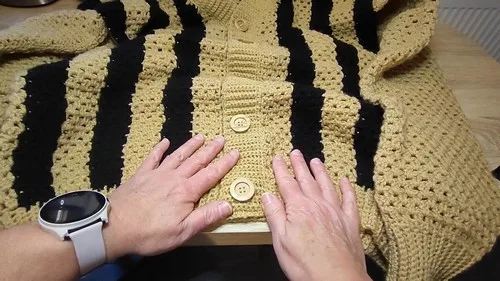
This jacket sits at the end of a project, not an evening. It starts small, with ribbing at the cuffs and hem, then grows into a full body and two sleeves. It needs patience more than skill. Black and beige carry the stripes, 200g each. The 4mm hook makes the ribs; the 5mm hook does the rest. It wants a chair with good light, a place to lay out fronts and back, and someone willing to count ribs twice before trusting the count.
In the basket
Abbreviations
- ch
- chain
- sc
- single crochet
- dc
- double crochet
Striped crochet jacket for men with ribbed trim
Ribbing (Cotes)
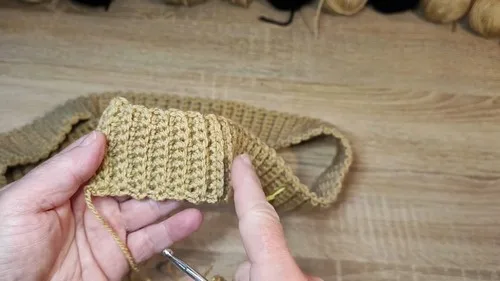
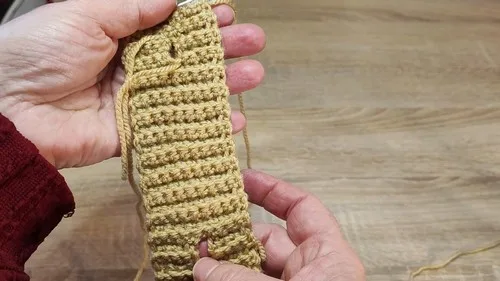
- Round 1Using the 4mm crochet hook, create a slip knot and chain 10 stitches; chain 1 (replaces first single crochet); work single crochet into the back loop only of each chain, starting from the third chain from the hook. (10)
- Round 2Turn your work, chain 1, and work single crochet into the back loop only for each stitch; always count to maintain 10 stitches per row; continue until you have 82 ribs (cotes), approximately 46-50 cm wide. (10)
Main Body (Front & Back)
Count 18 ribs from each end and place stitch markers; the section between the markers is the back of the jacket.
Use the 5mm crochet hook for stripes and the main body.
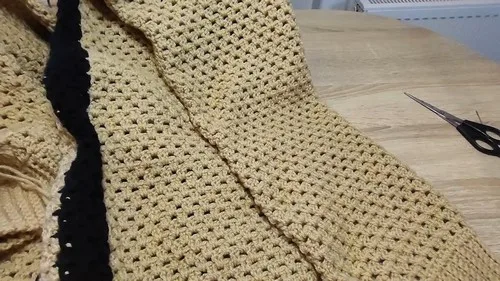
Each stripe is 3 ribs wide; for color changes, don't cut yarn, carry it along the back.
Start with a beige stripe, alternating black and beige across the front and back panels; the back will be all beige.
Repeat Rounds 2 and 3 until the piece measures 50 cm from the bottom of the ribbing.
Once the piece measures 50 cm, stop working the front stripes and continue with the point fantaisie in beige only for the back.
- Round 1For each stripe, pick up 6 stitches: one on the top, one in the middle, and so on; work each stripe with 6 stitches per color change. (6)
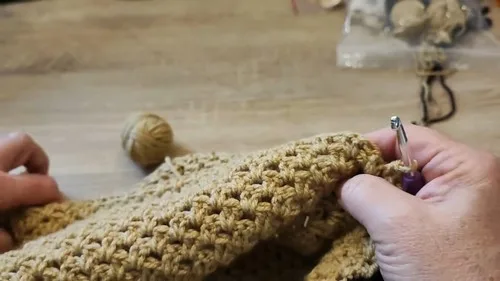
- Round 2Replace the first double crochet with 3 chain stitches; work 2 double crochets together in the same stitch; skip one stitch, and repeat.
- Round 3Replace first double crochet with 3 chain stitches; work 2 double crochets together, offsetting the motif.
- Round 4Continue with the point fantaisie using only beige yarn for the back until the back measures 80 cm in height.
- Round 5Work each front half separately, stopping at armhole height (30 cm); on the neckline side, leave the last two stitches unworked at the end of each row, skip the first two stitches on the next row; repeat for a total of 6 decreases; after decreases, continue until reaching 30 cm height for the armhole.
Sleeves
Make 2- Round 1Using the 4mm hook, chain 15 stitches; work single crochet into the back loop only for 24 ribs. (15)
- Round 2Change to the 5mm hook; pick up 48 single crochet stitches along the cuff edge; work the point fantaisie stitch pattern. (48)
- Round 3After 26 cm, make increases on both sides of the sleeve every 6 rows; continue until the sleeve measures 60 cm.
More pictures
Before the first stitch
- Check both yarn balls total 200g each; stripes rely on even amounts.
- Place stitch markers 18 ribs in from each edge before starting the main body.
- Read Round 1 of the Main Body first; the six-stitch stripe count sets everything after.
Minutes per piece
- Ribbing (cuffs and body trim) about 1-2 hours, because 82 ribs take steady repetition
- Main Body and Sleeves about 3-4 hours, because the point fantaisie shaping and neckline decreases need close counting
Other yarns that work
- Cotton, worsted weight Gives a crisper stitch definition for the point fantaisie, but drapes stiffer and may need a firmer hand on tension.
- Wool-acrylic blend, worsted weight Keeps the same hook sizes, but adds warmth and a softer drape than pure acrylic.
Where it ends up
- An everyday jacket for cool evenings, paired with a plain shirt underneath.
- A layering piece for walks, worn open over a sweater.
- A considered handmade gift, paired with simple trousers for a finished look.
Joining up
- Step 1 Sewing Shoulders: Use a tapestry needle to sew the front shoulder panels to the back.
- Step 2 Sewing Sleeves: Fold the sleeve in half lengthwise and sew the seam; attach each sleeve to the armholes of the jacket, using the appropriate color yarn for each side.
- Step 3 Weave in all loose ends.
- Step 4 Button Placket and Collar: Pick up 54 stitches for each front placket and 92 stitches around the collar; work single crochet stitches and create buttonholes every 9 ribs.
- Step 5 Sew Buttons: Position and sew buttons using a tapestry needle, ensuring proper alignment with the buttonholes.
Small notes
- Carry unused yarn along the back when changing colors. Cutting it each time wastes yarn and adds ends to weave in.
- Use stitch markers to hold the 18-rib count for the back section. Losing that mark shifts where the shoulders fall.
Little questions
Why does the ribbing need exactly 82 ribs?
That count sets the width, about 46-50 cm. Fewer ribs make a narrower band that won't match the body.
Can I skip the stitch markers for the back section?
I wouldn't. Eighteen ribs from each end mark where the back starts and ends. Without markers, it's easy to shift the shoulder line by a rib or two.
How do I keep color changes neat along the back?
Carry the yarn not in use along the back of the work instead of cutting it. This keeps tension even and avoids extra ends to weave in later.
What if my armhole decreases don't land evenly?
Recount the six decreases before continuing; each one leaves two stitches unworked at the row end. A missed decrease shows up as an uneven neckline once the fronts are joined.
Original pattern: https://crocheteverything.com/stylish-crochet-mens-jacket-pattern-with-colorful-stripes/

About the Author
Tamsin Okoro Who writes the patterns at Yarn Gallery, how a pattern gets from the hook to the page, and what this site will never do.